
March 26th, 2026
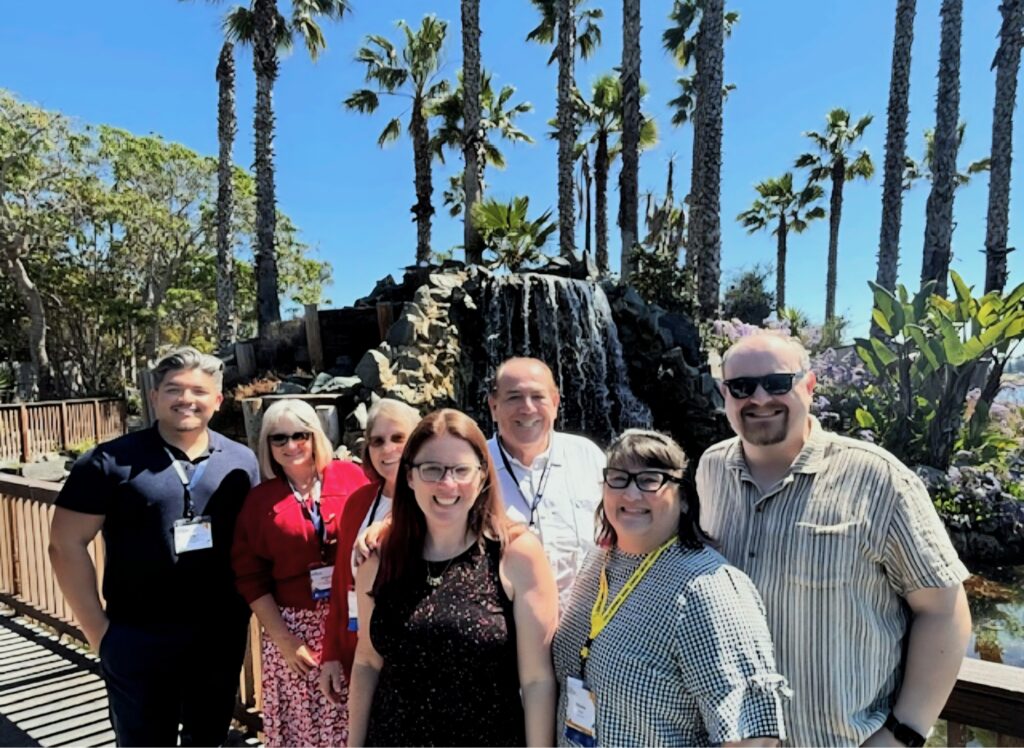
On March 18, 2026, the College Bridge team joined educators, researchers, and dual enrollment leaders from across the state at the California Dual Enrollment Equity Conference, in San Diego.
Presented by the California Alliance of Dual Enrollment Partnerships, Career Ladders Project, and EdTrust–West, the annual conference brings together educators committed to expanding equitable access to college opportunities for high school students.
College Bridge contributed to the conversation with a session titled “Intentional & Supported Dual Enrollment for Students Who Struggle.”
The session drew more than 70 attendees, demonstrating strong interest in approaches that expand dual enrollment access beyond traditionally high-performing students.
The presentation was led by Nicole Korgie, Vice President of Operations at College Bridge, alongside Owynn Lancaster, Vice President of Academic Strategy, and Kristi Rieg, math professor at Merced College.
Together, they introduced conference participants to the philosophy behind the Math Bridge model, an approach designed specifically for students who have struggled with or disengaged from math.
“Too often, dual enrollment is designed only for students who are already excelling,” Owynn Lancaster explained. “Math Bridge flips that assumption by intentionally creating college-level opportunities for students who might otherwise believe those opportunities aren’t meant for them.”
During the presentation, the team walked participants through the collaborative process that the Math Bridge project uses to help high schools and colleges determine which courses to offer and how to structure them.
Rather than relying on assumptions, the project begins with a careful analysis of student performance data, allowing institutions to identify where students struggle most and where additional support could make the biggest difference.
Participants also learned how the project identifies and pairs the right instructors to teach supported dual enrollment courses.
“We look closely at which high school and college instructors are the best fit to work together,” Kristi Rieg said. “It’s not just about the course content; it’s about building partnerships between educators who are committed to supporting students every step of the way.”
The session also explored recruitment strategies designed to reach students who may be hesitant to enroll in a college-level course. Attendees were especially interested in how Math Bridge instructors and counselors work together to identify, recruit, and encourage students who may doubt their own academic potential.
While the presentation used Math Bridge as the central example, the discussion quickly broadened to a larger question: What would it look like if supported dual enrollment models were applied across subject areas?
That idea sparked significant conversation during the session’s lively Q&A, as educators from across California asked how the approach could be adapted to disciplines beyond mathematics.
In addition, College Bridge’s grant partners from the Central Valley Higher Education Consortium presented the day before with a session titled “Random Acts to Roadmaps: Dual Enrollment in Rural Schools.”
Led by Kristin Clark, Dual Enrollment Lead, and Elaine Cash, Grants and Programs Lead & Dual Enrollment Coordinator, the presentation explored how rural partnerships across the Central Valley are building intentional dual enrollment pathways for underserved students.
“We were surprised to see how many people attended our session,” Elaine Cash shared afterward. “We realized how many regions share the rural challenges that we recognize here in the Central Valley.”
Attendees showed clear enthusiasm, snapping photos of slides, taking notes, and discussing ideas with colleagues throughout the session, signals that the strategies being shared were resonating. Notably, College Bridge’s Math Bridge project was highlighted as one of the innovative approaches helping rural schools expand dual enrollment access.
The presentation demonstrated how data-driven planning, strong instructor partnerships, and targeted student support can open college pathways for students who may have previously felt left behind in math.
Want to learn more about Math Bridge and the work College Bridge is doing to expand equitable access to college-level learning? Visit our website to explore the project and its impact.
